
The First Automated Philippine Elections
May 14, 2010 Your Comment
In this blog we talk about food, places and anything that has to do with travel to and in the Philippines. Politics is farthest from the subject matter and thrust of VisitPinas.com. But the 2010 election holds a special place in Philippine history and not because it’s a national holiday (see full list of 2010 holidays).
Voter Ad of the COMELEC for the 2010 automated elections
The May 10, 2010 national and local elections is the first time that the Philippines is using a fully automated system. Prior to this election the Philippines was using the manual system, from the voting, counting, canvassing and until the transmission of the results.
The prior system involves manually writing the names of the selected candidates — the President, Vice-President, 12 Senators, Congressman (House of Representative member), Governor, Vice-Governor, Sangguniang Panlalawigan members (Provincial Board), Mayor, Vice-Mayor and Sangguniang Bayan members (City/Municipal Council). The ballots are manually dropped into a ballot box, later retrieved by the Board of Election Inspectors (BEI). The BEI members then counts the votes, using their discretion whether what is written could be appreciated in favor of a candidate. Then the Election Returns (ER) are transmitted for canvassing, with manual process repeated at the municipal, district, provincial and national levels. It’s a long, cumbersome and tedious process — the results for the national positions are not known until about 2 months. Plenty of opportunity to cheat.
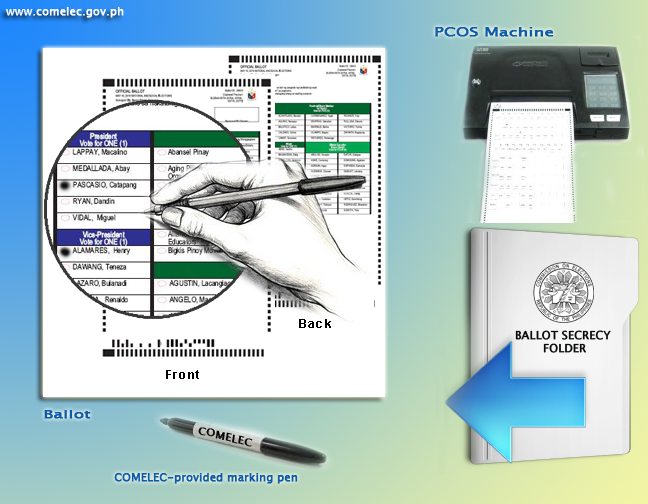
Now we have the “Precinct Count Optical Scan” or “PCOS”, which is a technology wherein an optical ballot scanner, into which optical scan paper ballots marked by hand by the voter are inserted to be counted, is located in every precinct. This is the system approved by the Commission on Elections (COMELEC) and provided by Smartmatic.
The names of all candidates are already printed on the ballots and the voter needs only to mark the small circle beside each name. Then it’s inserted into the PICOS machine, which then reads the ballot and stores the information. Once the voting closes at 6:00 p.m. (extended to 7:00 p.m.), the BEI simply presses the right buttons, then the PCOS machine tallies the results and transmits the results to the main server. Fast and efficient.
Of course there were glitches, considering that this is the first time this is implemented in our country. There are also improvements, to be sure. Still, would you say the first automated elections in the Philippines was succesful? Please use the comment section below.
 Loading ...