

Memories have a funny way of affecting the present, we all know, which is why we’ve waited for the rainy season to write about our summer trip to Palawan. Any dour rainy season spirit would be uplifted by memories of the flickering rays of sunlight that playfully glide across the emerald green waters of the Twin Lagoon in Coron, Palawan. We could have written this post last summer, right after we’ve visited the beautiful Palawan, primarily Coron, but chose to wait for the last quarter of the year, the tail end of the rainy season.
There’s usually a legend that wraps around a place or a concept. There’s a legend of how giants created Bohol’s world-famous Chocolate Hills. There’s a legend of how the Philippines was founded. Surprisingly, there’s none for the Twin Lagoon. There’s a legend about the nearby Siete Pecados in Coron, but no legend surrounds the Twin Lagoon. So let’s create one. Maybe, a long time ago, there were twins, one wicked and the other good. To protect the good twin, the gods in their infinite wisdom decreed that they be separated forever, but left a small link as a recognition that the kids are twins.
Yes, that story may sound flimsy at best. Maybe you guys have a more creative version, so feel free to tell the story through the comment section below. First, allow us to defend our version of the Legend of the Twin Lagoon. And before that, let’s agree that it’s Twin Lagoon. It’s neither Twins Lagoon (doesn’t make sense because the focus should be on the two lagoons) nor Twin Lagoons (which would really make sense because the name has reference to two lagoons).
The leisurely boat trip to the Twin Lagoon takes around 20 minutes from Siete Pecados, another favorite tourist destination in Coron. That should be enough time to talk about legends, or anything under the sun, but a relaxing conversation is made almost impossible with the breeze and the high-decibel chug-chug-chug of the banca’s engine. So you let the sun work its magic in growing a tan (gluta users have the option of staying under the boat canopy) and leave the talking once you get to the destination. Plenty of time to talk, you say, but you’d be wrong.
You see, by the time the boat approaches the rock walls hidden hills, the seawater turns from dark blue to light blue, punctuated by white sand (or stone?) that lies underwater. Soon it will turn into a gentle emerald green. Of course, you don’t get to talk about anything, legends included. You’d most likely say, “wow!” You’ll know you’ve arrived at the destination because millions of boats (ok, not millions, just around 10 at any given time, a lot of tourists) are parked in this hidden lagoon. This is the first of the twins. The wicked one, we suppose, because the other twin, the good twin in our legend, is safely hidden somewhere.

There’s a wood/bamboo walkway that hugs the vertical rock cliff in the first lagoon. The elevated walkway, stilts protruding from the water, doesn’t look much. It’s the last vestige of pretension for those who have no intention of getting wet in this sea paradise (this is Palawan, for crying out loud, one has to taste the sea). Those who have misplaced hopes of staying dry will soon find out that the walkway leads nowhere. It abruptly ends. And the message becomes clear — to get to the other twin lagoon, any visitor must get soaked in seawater.
How to get to the second lagoon? Good question. Same question we asked when we arrived at the destination. The tour guide pointed to a wooden ladder that looks painfully sandwiched between two gigantic rock towers. Those who are weight-challenged will find the fit very interesting. That is, if they can clamber to the first rung of the stairs. We’ve seen some of the guests go that way. Not fun. Not exciting enough. Not dangerous enough. So we pass through the umbilical cord that binds the twins, the only link left by the olden gods when they decreed to separate the twins forever. We had to go under the rocks.
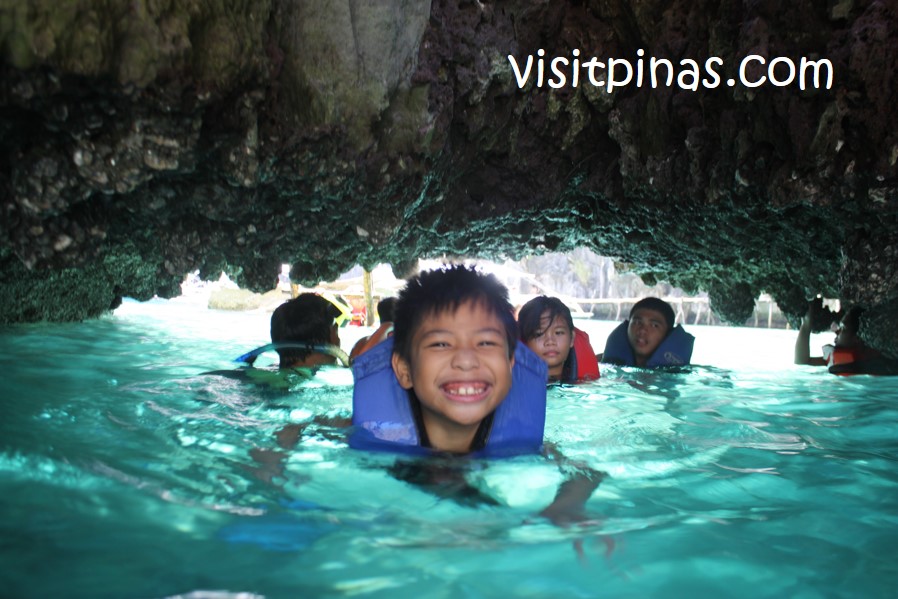
We strongly recommend that you pass through the more scenic route — through the cave. There’s a little hole, completely submerged in water during high tide, that leads to the other lagoon. It’s more fun to visit the Twin Lagoon during low tide. Tour guides know that. With less than a meter of head room, this rock-mouth is littered with sharp rocks and barnacles. Some use kayaks when going under, lying flat on their back to avoid decorating their tanned skins with rock-inflicted scratches. We chose to swim, buoyed by the life vests that happily allowed us to focus on avoiding bumping our heads on the cave ceiling.

It’s supposed to be dark through this passage. It’s surprisingly bright, like there’s a huge light source underwater that floods the surrounding area with emerald-green light. Those who have been traumatized by Jaws or any other movie that uses the fear of the underwater unknown would probably feel at ease in this place. You’d soon forget about the rough rocks, or what lies underneath, mesmerized by royal beauty of the sight. A few kicks forward and you’ll be transported to yet another display of natural beauty. The second lagoon. The second twin.
Solid rock cliffs guard the edges of the second lagoon. The waters should ordinarily be calm but excited tourists flapping about creates soft waves that render the task of handling the camera, while trying to swim, more challenging. Even if the water is deep, we recommend bringing a snorkel, something which must be on hand everywhere in a Coron tour (except the city tour, if we may add).
So, there you go, a defense of the Legend of the Twin Lagoon. Our version of it, anyway. It may not be captivating. You may very well have a more interesting story to tell. Feel free to tell your story. You get to tell the world about the Philippines. At the very least, you get to relive the happy thoughts while at the Twin Lagoon, a great way to wash away the gloomy atmosphere of any rainy day.
The place looks nice. We will visit Coron next summer. Thanks!